|
|
| INTRODUCTION
HOW TO DRAW (Updated) |
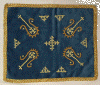
Introduction This site is in memory of my beloved parents Boghos (Paul) and Berjouhi (Dermenjian) Derharoutunian. Several of the embroidery items photographed in this web site were made by my mother. I will treasure these exquisite and beautiful pieces which have a very special place in my home and in my heart. This web site is
specifically for Armenian embroidery of Marash ( Armenians today are blessed by the diversity and richness of a heritage passed on by thirty centuries of rich culture and diligent practice. Few have felt the burden to preserve and remember those who worked hard to keep Armenian heritage alive and preserved in many museums. Armenian women, regardless of birthplace or habitat, were usually familiar with the art of making various kinds of fine needlework. Today things are different. With many women working and having professional careers, it is very difficult for them to make time to learn these beautiful embroideries. However, somebody has to keep passing on the art of making these beautiful pieces and teaching the next generation. My love and fascination for the Armenian heritage and needlework made me put this web site together, in the hope of motivating others to join in the effort to preserve the art. While individuals are encouraged to start learning and making these embroideries on their own, I especially encourage the formation of groups (clubs) interested in embroidery to meet regularly so the group members can assist and support each other.
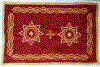
This is an
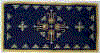
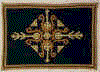
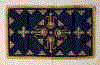
item of Armenian embroidery. It is a picture of the Armenian Cross (Khatchkar/
To see a larger size of the Armenian Cross click on the picture or click here.
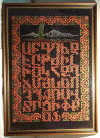
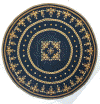
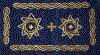
For a larger size of the Armenian alphabet click on the picture or click here. Haigazian University (Beirut) Logo The following is a photo of an embroidery logo of Haigazian University.
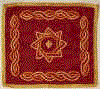
Haigazian University was established in Beirut, Lebanon, in 1955. Its logo represents its heritage, its history and its present ties; it has four parts depicted on the sides of the Armenian cross, the Armenian Khatchgar: Mount Ararat, represents the Armenian heritage; the Cedar tree represents Lebanon, the University's place of birth and the host country for one of the lagest Armenian communities in the diaspora after the Armenian Genocide of 1905; the lamp represents service of the university to its host community and its students, faculty and staff, and the book represents the source of wisdom and knowledge. The road that links Mount Ararat and the Cedar tree, represents the integration of the two aspects of the Armenian identity. In the center stands the Armenian cross and in its center the Armenian symbol of the eternal sun. The two concentric circles contain the name of the university in Arabic (top), Armenian (bottom left) and English (bottom right). Photos of other Embroidered Items Following are other items of Armenian embroidery. They include a bedspread, pillowcases, tablecloths and table runners:
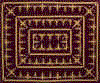
This is a picture of a king size bedspread. To see a larger size of the bedspread click on the picture or click here.
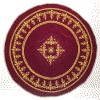
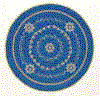
These are the round tablecloths. To see larger sizes click on any picture or click here.
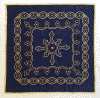
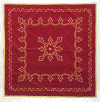
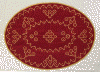
These are square and oval tablecloths. For larger sizes click on any picture or click here.
These are pillowcases. For larger sizes of the pillowcases click on any picture or click here.
These are different colors and sizes of table runners. To see larger sizes of all the table runners click on any picture or click here.
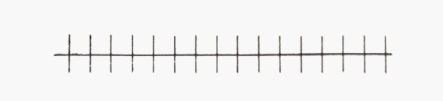
Basic Armenian Embroidery Stitches I thank my sister Ankine who taught me Armenian embroidery. One day she insisted on teaching me. I was surprised how quickly I learned and completed several pieces myself. The stitch looks complicated but when one gets the idea of how it is done the work is easy, enjoyable and rewarding. Also, it is very important that one tries and tries again. Included here are various stitches reproduced from the book entitled Marashi Aseghnagordsoutyune (The Needlework of Marash) by Serig Davtyan published in Armenian in 1978 in Erevan. Also, some pages were reproduced from Armenian Needlelace and Embroidery by Alice Odian Kasparian. You will need a design and a fairly thick cotton thread or DMC thread. I will cover the steps of how to draw your own design at home in the next section without using any complex machines or tools. The designs are printed on the fabric in different ways; some are stamped on fabric with carved wooden stamps while others are painted on the fabric with a brush or steel pen dipped in a special paste. The design may also be drawn at home on a clear plastic sheet or translucent paper for easy positioning; the plastic or the paper is then perforated along the design lines to allow paint to penetrate into the fabric, and the plastic sheet is then painted along the perforations while it is held against the fabric. This design method will be explained below in more detail. To start learning the basic embroidery stitching, you need to draw a line (with a pencil or colored pen) just like the line below on a piece of white cloth. You also need thread and needle to practice. Remember practice, practice and practice. Practice makes perfect.
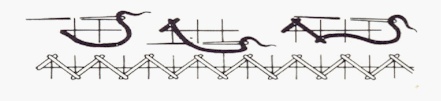
1st step: Work a row of herringbone or fishbone stitch just like the picture below
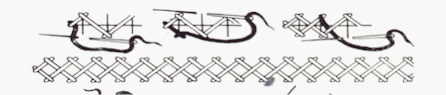
2nd step: Work a second row. The foundation must be correct, otherwise the 3rd and 4th steps cannot be worked accurately. Each bar of the herringbone on both ends should be either over or udder the stitches. Make bars once over and once under alternately to the end just like the picture below.
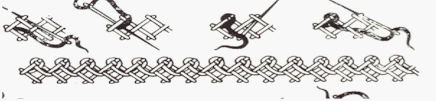
3rd step: Work the top row of interlacing by threading the up-slanting stitches underneath the others just like the picture below.
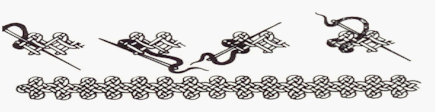
4th step: Work the bottom row of interlacing by threading the down-slanting stitches underneath the others, following the exact direction of the stitches just like the picture below.
The first row of the fishbone stitches has the second row superimposed upon it. While working the second row of fishbone stitches, the needle is passed under the working thread of each stitch instead of over it. The base of the foundation of the first and second rows should not be worked tightly, because in interlacing the threads superimposed on the first and second rows, the weaving thread tends to draw the stitches together. The third row is worked by filling in the upper or lower outline by a darning type stitch. The fourth row completes the process by weaving in and out of each stitch until the work is completed. Marash Embroidery is a very precise embroidery. There can be no errors in working it or the weaving will not come out perfect. The first and second fishbone stitches are the foundation stitches and will show on the back; all the rest of the weaving is done on the surface. While working the third and the fourth row do not pierce fabric. Slide needle between fabric and existing stitch. In the Encyclopedia of Embroider Stitches by Marion Nichols, you can see a description of this stitch, the author calls the stitch German Interlacing or Maltese Interlacing. Regardless what it is called, this stitch is derived from Armenia. After you have practiced these basic stitches, follow the designs below for making more complicated patterns. These are different designs that you can try to practice after you have mastered the basic stitches above. You can click on the link below to see different designs and explanation of each designs.
This section will be continuously revised and updated to illustrate how to draw new designs. Please click here to see the illustration. All of the pieces shown on this web site are also available in finished form. They are available from Armenian church organizations, orphanages and various other charitable groups. I have access to Armenian charitable organizations and I am interested in promoting their products. I am therefore able to supply a limited amount of finished products . This web site was created in support of the LADAH FOUNDATION, a non-profit, tax-exempt organization. Hence, net proceeds of any sale will be donated to Armenian charitable organizations. You may inquire about and order finished products by sending your email to hildaladah@hotmail.com This site is in the process of being developed and will continue to be revised and improved. Please send any comments, corrections or additions, through the email procedure you normally use, to the email address below or click on the link below to send your email message if your browser is set up. href="mailto:hildaladah@hotmail.com">hildaladah@hotmail.com Last updated on June 27, 2022 © 1999 Prepared by HBL - All Rights Reserved |
|
|
|



 ) origin. It is also called
Armenian interlaced embroidery, also referred to as Marash (
) origin. It is also called
Armenian interlaced embroidery, also referred to as Marash ( ) embroidery. It is called Marash (
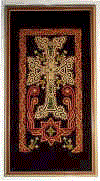
 ) made on velvet, a masterpiece of
Marash (
) made on velvet, a masterpiece of
Marash ( ) embroidery. "Khatchkar/